



Editor’s Note: Interested in free weekly updates from Northern Michigan? Sign up for the WEEKLY PINE VIEW
By Mark Constance
MIO — Before dawn breaks, Michael Gingerich is up on his 154-acre Oscoda County farm, milking cows and preparing for another day. He and his wife, Kristina, are raising a family while operating a dairy that reflects their Amish values of hard work, family, and tradition.
Gingerich said he didn’t grow up on a dairy farm, though his family raised calves and veal when he was a boy. His father moved to Michigan from Ohio in 1971, when he was 12 years old, and later worked at a sawmill and ran a greenhouse.
“We bought the farm in 2012 and moved here in 2013,” Gingerich said. “I was born and raised in the area. I grew up over on Galbraith Road.”
Kristina also grew up in an agricultural household. Her parents moved from Indiana when she was 12. Their property backs up to the Gingerich farm and is connected by a trail.
The couple’s nine children help with chores, from milking cows to managing the family’s maple syrup operation.
“We’ve got about 2,000 taps of maple trees, so that keeps us busy in the spring,” Gingerich said.
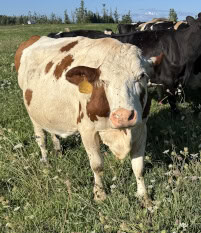
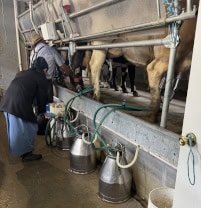
The Gingerichs milk almost 50 cows a day. The family does not plant cash crops, though they maintain hayfields, food plots, and pasture.
“Just dairy — that’s our focus,” he said.
Of the farm’s 154 acres, 90 are fields. The rest is woods and swamp. To supplement feed, Gingerich rents ground nearby to cut hay and rotates pastures with Sudan grass, a crop that grows quickly in summer.
“I planted it the first of June, and 35 or 40 days later it was up to my waist,” he said. “I grazed it three times this year. It grows fast and does better in the dry weather than just regular pasture.”
He irrigates parts of his land to keep pastures green through dry spells. “You can almost see the difference between the green and the yellow,” he said.
As with most Amish farms, horsepower is literal. Gingerich keeps six workhorses for tilling, hauling manure, and other farm work.
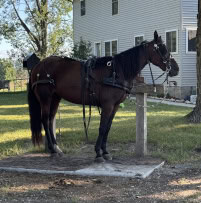
“Right now, we’ve got six,” he said. “We use five main horses, but one is older. We haul a couple hundred loads of manure a year.”
That manure, he added, is the farm’s fertility system. “That’s my fertilizer,” Gingerich said. “We keep it all for our own purposes.”
A single large bull also roams the pastures with the dairy herd, while calves are either sold or kept for breeding. “We keep the heifers as replacements,” he said.
The Gingerich’s, like many farmers, contend with challenges ranging from last Spring’s ice storms to summer heat. “We had ice damage on some of our trees,” Gingerich said. “That was pretty brutal.”
In hot weather, he brings cows into the barn to keep them cool. Fly control is another constant battle. Strips of sticky tape hang in the barn, catching thousands of insects each week.
“It’s not nearly as bad as it used to be, but it can still be a challenge,” he said.
Power on the farm comes not from the electric grid, but from diesel engines and line shafts that run the milking equipment.
Today, Gingerich is one of six contracted milk providers for the Farmer’s Creamery in Mio, which allows local Amish farmers to sell their milk cooperatively. By pooling their milk, the farmers can sell locally and maintain a direct link to Michigan consumers.
Prior to the creamery, he sold through the Michigan Milk Producers Association, where prices fluctuated sharply.
“This ensures we get a stable price for our milk,” he said. “I can’t go out and sell my own milk,” Gingerich said. “ I like the idea of just selling your milk to a local creamery, and then it gets distributed right here in Michigan. You can tell people in Michigan, ‘That’s our milk,’ and they like that connection.”
Gingerich said what keeps him committed to dairy farming isn’t just milk prices or tradition — it’s raising his family with purpose. He and Kristina have nine children, three boys and two girls ranging from 1 to 18-years old
“I did not grow up on a dairy farm,” Gingerich said.
“But the idea of a family farm always attracted me — everybody working together. One of the goals is raising a family in that environment, where we can be together.”