



By Michael Busch
& Mark Constance
Editor’s note: The tragic death of an Ogemaw County woman at the hands of her husband last December prompted us to try and bring more awareness to the risks of domestic violence.
“I thought she was going to kill me”
NORTHERN MICHIGAN – Control, isolation and violence. These are the hallmarks of domestic violence (DV).
How common are domestic assaults in Northeast Michigan? More than you may think.
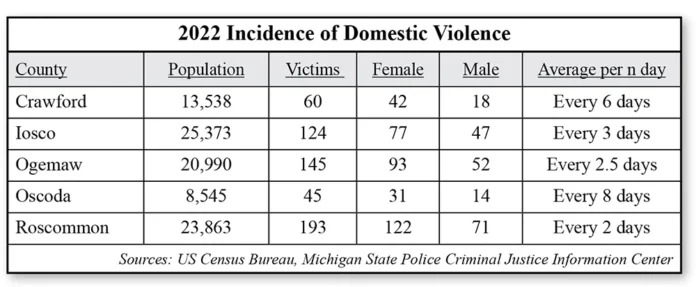
There were 567 complaints to police in 2022 across the Up North Voice coverage area, which encompasses Roscommon, Ogemaw, Crawford, Oscoda and Iosco counties. The highest was Roscommon County, which averages a DV complaint every two days. (See graph)
But many instances of domestic violence are not reported. Practical concerns, such as the fear of losing what security they do have, housing, employment, and children, can complicate decision-making.
Trauma bonding
Trauma bonding, or the relationship between offender and victim, is what keeps people together.
The victim is first treated with great affection or “love bombing.” Soon after, the abuse occurs and the offender apologizes. The victim forgives the offender and renews trust.
Yet, the cycle of love and abuse continues. The trauma bond keeps victims in place because, over time they lose their sense of identity and self-worth.
Emotional barriers can also make the situation worse. Some victims have a childhood history of abuse and assume their current situation is normal.
Roscommon County Undersheriff Ben Lowe describes the victim’s perspective as living in a comfort zone.
“What we know – even if it is not the healthiest thing for us – is often where we are the most comfortable,” he said, adding that victims are caught in a trap of emotions that prevent them from leaving until the situation is out of control.
“Most of the time the concern is that victims need to realize they need help.”
The breaking point
Ask any DV survivor about their experience and they mention two things about their abuser: The need to exercise power over the relationship.
“The control started pretty early on,” said Patti Carter of Roscommon County. “There was a lot of jealousy over my friends and my family. Anyone who cared about me.”
Carter said initially she wasn’t consciously aware of what was happening. Within the first six months of starting the relationship, physical violence began.
“It’s a lot more subtle than people think it is. It starts verbally and progresses to physical. You just kind of get used to it,” she said.
Carl Simmons of Ogemaw County is a veteran who served two tours in the Middle East. He’s physically much larger than his abuser.
“I felt like no one was going to believe it was happening because I was so much bigger than her. So I didn’t tell anyone.” he said. “I just took the abuse. You hope that it will get better, but it doesn’t.
“I spent two tours overseas and I felt safer there than I did in my own home.”
Simmons said he ignored the most obvious sign of abuse: Isolation. He hadn’t spoken with his family in more than a decade, but has since reached out to rebuild those relationships.
He said an incident with scalding water pushed him to report to police. His partner also loaded three weapons. She had taken his truck keys, cell and wallet.
“I thought she was going to kill me,” he said. “When I got to the Michigan State Police post, two troopers came around the corner to talk to me and I just started crying. Going to the police was the toughest thing I have had to do.
“I was broken and damaged, physically and emotionally,” Simmons added.
Carter was able to escape her relationship with the support of her friends and family. But she said support is just one component of the “leaving” process.
“I started therapy about a year before I got the courage to leave,” she said. “I had to make myself stronger to do it.”
She worked with the therapist to create a safety and escape plan. When the time came to move, the situation at home became even more hostile. She fled to a women’s shelter for a brief time, but continued to work, and found a support group.
As Carter looks back on the experience, she said, “It’s been difficult, but when you look back at it you can see how awful it was and how it affected the people around me.
“I’ve put a lot of work into regaining my relationships with friends and family because I had been keeping a secret. I was isolated from them so much.”
The law and it’s affect on victims
If pursued, many domestic violence complaints end in convictions. But that doesn’t make the process any easier.
In Simmons’ case, there was a conviction, but the penalty was a delayed sentence, where the conviction will be dismissed after a period of time if his partner doesn’t commit any more crimes.
“You serve more time in jail for a DUI than you do for domestic violence,” Simmons said. “But they look at a complaint like that’s the only time it happened, but it happened many times before.”
Carter’s initial experience with the law and DV was when she tried to leave. She had texts and audio recordings of abuse of her and her animals, but had never reported it, despite having a loaded shotgun poked into her chest.
Police came to the house and told her she could leave, but said her son had to stay with her abuser. She stayed because she had to. But not for long.
Her situation came to a head when she finally fled to a family member’s home. She was later granted a personal protection order (PPO) while staying at the Women’s Resource Center in Traverse City with her 3-year-old son.
There were convictions of her abuser for multiple PPO violations, but was just fined because the convictions were considered a first offense.
What it takes to leave
Simmons encourages victims to file their complaint with the Michigan State Police or a shelter. He said the process of reporting an assault can be traumatic.
“You need to go deep,” he said. “It takes a lot. You have to decide whether you want to do this the rest of your life. You need to decide you want to get better and that you want to get out.
“Because it only gets worse.”
Note from Mark Constance: Carter and Simmons had their names changed to protect their identity as victims. Both were personally interviewed by Mike Busch and myself. I can be reached at 989-275-1170 or [email protected].
▶ Watch for the second part of the Up North Voice series on Domestic Violence in the March issue.
