


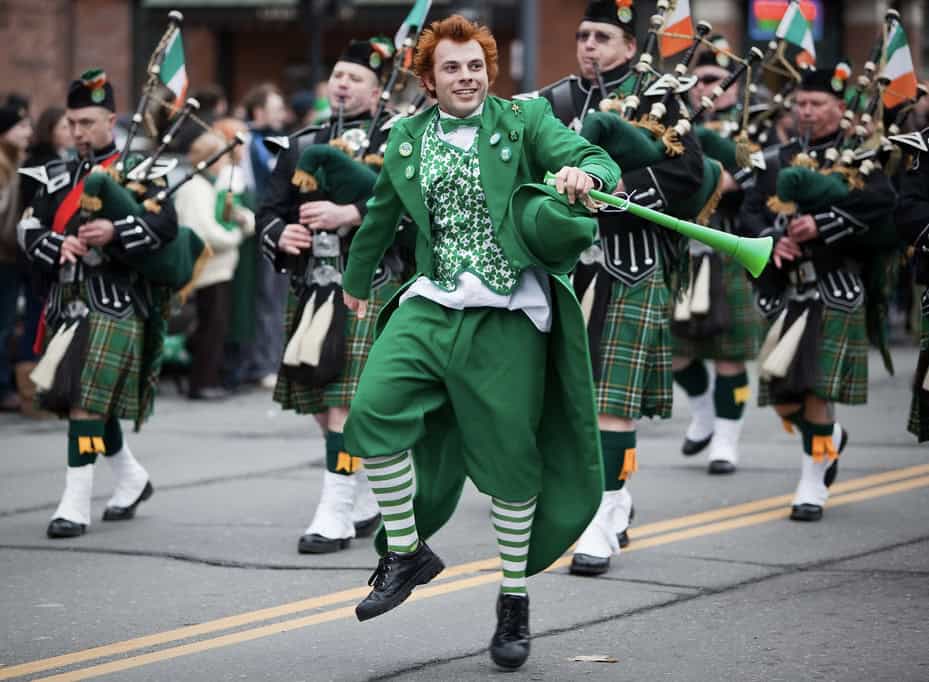
St. Patrick’s Day, celebrated annually on March 17, honors the patron saint of Ireland, St. Patrick.
Although never officially canonized by the Catholic Church, he has long been revered for his efforts in bringing Christianity to Ireland. Born in Roman Britain in the late 4th century, he was kidnapped at the age of 16 and enslaved in Ireland.
After several years of servitude, he escaped and returned home, only to have a divine vision calling him back to Ireland to convert its people to Christianity. Around 432 CE, he returned as a missionary, establishing churches, monasteries, and schools. Over time, numerous legends arose about him, including the famous tale of driving the snakes out of Ireland and his use of the shamrock to explain the Holy Trinity.
St. Patrick died on March 17, 461, and his death became the focal point for annual commemorations that later evolved into St. Patrick’s Day.
Originally, St. Patrick’s Day was a solemn religious feast day in Ireland, primarily observed through church services and modest celebrations. However, it was Irish emigrants, particularly in the United States, who transformed it into the festive and large-scale celebration it is today.

The first known St. Patrick’s Day event in America took place in 1600 in St. Augustine, Florida, then a Spanish colony. A year later, historical records suggest that a St. Patrick’s Day parade was held there. However, it wasn’t until the 18th century that large-scale celebrations became more common in cities with growing Irish populations, such as Boston and New York.
In 1737, Irish soldiers serving in the British military marched in St. Patrick’s Day festivities in Boston, and New York City followed in 1762 with a similar parade.
Over time, Irish patriotism in America led to the formation of Irish Aid societies, which organized annual celebrations featuring bagpipes and drums. By 1848, various groups in New York City united to form the official St. Patrick’s Day Parade, which remains the largest in the world today.
Other cities followed suit, making it a nationwide tradition. The holiday’s popularity grew beyond just Irish communities, and in 1991, the U.S. Congress and President designated March as Irish-American Heritage Month, recognizing the significant contributions of Irish Americans to the country.
In contrast, Ireland maintained a more religious approach to St. Patrick’s Day for centuries. Until the 1970s, Irish law required pubs to close on March 17, and the day was largely centered around church services and small family gatherings.
However, in 1995, the Irish government began using St. Patrick’s Day as a means to promote tourism. Today, Dublin hosts one of the most significant St. Patrick’s Day festivals, featuring parades, concerts, and cultural events that attract visitors from around the world.
In the United States, St. Patrick’s Day is celebrated with parades, the wearing of green, and the consumption of traditional Irish and Irish-American foods. The tradition of wearing green is tied to Irish folklore, where green is believed to make one invisible to leprechauns, mischievous creatures said to pinch anyone they can see.
Corned beef and cabbage, now a staple of St. Patrick’s Day menus, became popular among Irish immigrants in the 19th century as a more affordable alternative to ham. Another American-born tradition is the famous green beer, which is not commonly consumed in Ireland but has become a hallmark of St. Patrick’s Day celebrations in the U.S.
One of the most unique American traditions is the dyeing of the Chicago River green, a practice that began in 1962.
Originally, plumbers used green dye to track pollution in the river, but the idea was later adapted into a St. Patrick’s Day tradition. Today, several other cities, including Indianapolis and Savannah, dye fountains and waterways green in honor of the holiday.
While St. Patrick’s Day is generally seen as a joyous celebration of Irish culture, it has also faced criticism, particularly regarding excessive drinking. Many cities have implemented measures to curb public intoxication during festivities.
Additionally, debates over inclusion, particularly regarding LGBTQ+ participation in parades, have led to controversies, most notably in Boston and New York. Over the years, however, many parade organizers have revised policies to be more inclusive.
Every March 17, the United States transforms into an emerald-colored country for a day. Green clothing, decorations, and even food dominate the festivities. Restaurants and bakeries offer green bagels, milkshakes, and grits, while bars serve pints of Guinness and Irish whiskey. Parade-goers line the streets to watch step dancers, marching bands, and bagpipers celebrate Irish heritage.
Yet, many of these traditions were not imported from Ireland but were instead developed in the United States by Irish immigrants who sought to honor their roots while establishing a sense of community in their new home.
Boston has long claimed to host the first St. Patrick’s Day celebration in the American colonies. On March 17, 1737, more than two dozen Presbyterians from Northern Ireland gathered to honor St. Patrick and establish the Charitable Irish Society, which aimed to assist Irish immigrants in distress. This organization still exists today and continues to host an annual St. Patrick’s Day dinner.
However, historian Michael Francis discovered evidence that St. Augustine, Florida, may have actually been home to the first St. Patrick’s Day celebration in America. Spanish gunpowder expenditure logs from 1600 indicate that cannon blasts or gunfire were used to honor the saint, and a parade was held the following year.
The largest and most famous St. Patrick’s Day parade in America, however, has its roots in an unexpected place: the British Army.
In 1762, Irish-born soldiers serving in the British military marched through lower Manhattan to a St. Patrick’s Day breakfast at a local tavern. Over time, these parades became a tradition, but they also attracted anti-Catholic and anti-Irish sentiment.
In the early 19th century, nativist mobs engaged in “paddy-making,” a practice where they erected offensive effigies of Irishmen dressed in rags, adorned with potato necklaces and whiskey bottles. The practice was eventually banned in 1803, but anti-Irish discrimination persisted for many years.
The food most associated with St. Patrick’s Day—corned beef and cabbage—is also an American innovation.
In Ireland, ham and cabbage were more common, but for Irish immigrants in the U.S., corned beef was a cheaper and more accessible option. Many Irish Americans living in lower Manhattan purchased leftover provisions from ships returning from China’s tea trade, which often included corned beef. Over time, this dish became a staple of Irish-American cuisine and an essential part of St. Patrick’s Day meals.
Despite its complex history, St. Patrick’s Day remains one of the most widely celebrated holidays in the U.S., embraced by both Irish and non-Irish alike. Whether through parades, food, music, or festive traditions, the holiday serves as a vibrant reminder of Irish heritage and the lasting influence of Irish immigrants on American culture.
Sources: