


Editor’s Note: Interested in free weekly updates from Northern Michigan? Sign up for the UP NORTH VOICE MAIL
By PATRICK BEVIER
Common Loons are among the most mysterious avians in Michigan. They are located in most of the Up North Voice coverage area, including Oscoda and Iosco counties.
To unravel some of the mystery, here are some fascinating facts about these beautiful, bewitching, and boisterous birds:
Name Game: The scientific name of the Common Loon is Gavia immer. It’s derived from Latin and translates to, “seabird” who “immerses” itself in water. Another name is Great Northern Diver, which acknowledges their amazing underwater skills
Deadly Divers: When pursuing fish, loons can dive to 200 feet! They torpedo through the water with powerful thrusts of webbed feet and have solid bones which make them less buoyant. They can spend an amazing five minutes underwater and are heavier than other waterfowl at over 13 pounds!
Not So Ducky: Although loons resemble ducks in shape and behavior, they are not members of the duck family. Differences are loon’s spear-like bill, huge, webbed feet located further back on the body, and lower profile in water. Males and females resemble each other while gents are up to 15 percent larger.
Still Uncommon: Although population numbers are slowly rising Common Loons remain a threatened species in Michigan. It’s estimated that we have about 700 nesting pairs which makes it important to not disturb them during mating and chick seasons.
Northern Nooks: Among many others, Up North lakes that host mating pairs include Loon and Island Lakes in Oscoda County and Avery, West Twin, and Voyer Lakes in Montmorency County.
Loquacious Loons: Loons emit a variety of unique vocalizations. In fact, they produce four distinct calls (wail, yodel, hoot, and tremolo). The iconic wail is associated most with loons, and is a prolonged, haunting bellow that is used to signal their whereabouts to faraway mates.
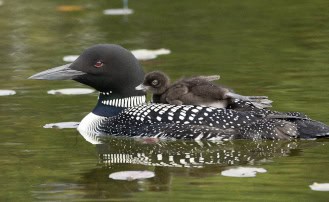
Summer Love: Loons generally mate for life. In Michigan they arrive in April and prepare nests made of contoured marsh vegetation in May. Clutch size is one or two eggs that the pair takes turns incubating. The fully feathered, brownish gray loonlets hatch in 26-29 days and begin swimming almost immediately.
Longest Lovers: Michigan boasts the oldest known loon pair in the world! Named “ABJ” and “Fe,” they began nesting in the U.P.’s Seney National Wildlife Refuge in 1997! It’s estimated that this dynamic duo has produced up to 40 “Yooper” loonlets!
Piscatorial Palettes: Loons consume more fish than anything else but will also gobble crayfish and aquatic insects. While teaching them how to hunt, parents feed the chicks for months.
Flying Phenoms: Loons prefer large bodies of water because they have a difficult time lifting off but once airborne, can fly at 75 miles per hour and amass hundreds of miles of flying distance without rest!
Those are some Common Loon characteristics about these not so common creatures. With luck you’ll encounter one or more on the wonderful waters of the Wolverine State!