



By Jacob Wheeler
“Never in my 23 years as a small-business owner have I felt obstructed by our national government in my ability to operate, manage and grow my business as I do now under President Trump,” wrote Grocer’s Daughter Chocolate co-owner Jody Hayden in late July. “Like many small businesses, we’re feeling the effects of a very uncertain and volatile global economy.”
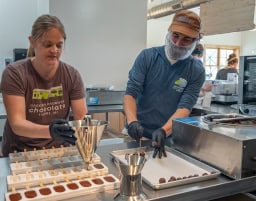
Grocer’s Daughter sources chocolate from Ecuador. On its latest shipment, valued at $171,500, the Empire-based company paid a tariff of $24,725 after Trump raised duties on Ecuadorian products to 15% on July 31.
Very little cacao grows in the U.S., so chocolate companies import nearly their entire supply. The devaluation of the U.S. dollar has worsened the situation.
“Extreme tariffs such as these are a reckless experiment at the expense of the American people,” Hayden wrote. “And these tariffs alienate the United States from dozens of our allies around the world.”
Tariffs and other federal policies have rippled through northern Michigan agriculture, raising costs, creating shortages and cutting research and services. Some wineries benefit, but many farms see profits shrink.
Global cocoa prices remain high after peaking at $12,700 per ton in 2024. Cocoa still trades at more than $7,000 per ton — triple last year’s cost.
“We’re keeping a close eye on our costs, and any price increases you may see this year are a direct result of two major factors: the newly implemented 15% tariff on chocolate imports and the devaluation of the U.S. dollar — both driven by current national policies,” Hayden told customers. “These challenges are real, but so is our commitment to quality, transparency and a better world.”
Last year Grocer’s Daughter raised prices slightly in response to record cocoa prices, which Hayden said are now the industry norm. “We remain committed to making high-quality, ethically sourced chocolate — and to being transparent with you every step of the way.”
Coffee shortages, market chaos
John Arens, co-owner of the Glen Arbor-based Leelanau Coffee Roasting Co., said tariffs “have had an awful effect on the entire coffee supply chain, especially the terrible 50% tariff on Brazil.”
In late July Trump raised tariffs on Brazilian goods from 10% to 50%, a move widely seen as political retribution for the coup trial facing former President Jair Bolsonaro.
Brazil supplies about 35% to 40% of the world’s Arabica beans. “These are no longer economically viable in the U.S., which creates a vacuum other nations can’t fill, creating shortages and market chaos,” Arens said. “This is on top of a bad year already, driven mostly by computerized commodity market trading.
“I sorta ‘get’ the idea behind some of the tariffs,” he added, “but the rollout and market prep has been absolutely horrific. America doesn’t have the climate to grow coffee, so this part seems ill-considered and uninformed, frankly.”
Fertilizer, tractor parts cost more
Farmers import fertilizer primarily from Canada, a top supplier of potash. This fall, Leelanau growers will pay an extra 10% tariff.
If they upgrade or repair equipment — as farmer Jim Bardenhagen does to his Deutz-Fahr tractors — they’ll pay even more. The German company announced in April it would pass tariff costs on to U.S. customers.
“It makes the cost of producing hay more expensive,” Bardenhagen said.
He also worries about proposed Trump administration cuts to NOAA, including eliminating the Office of Oceanic and Atmospheric Research and slashing climate and weather research. “We get information from them daily on wind and rain,” he said. “We live by the weather.”
A freeze in late April destroyed much of the region’s cherry crop. Farmers harvested 33 million tart cherries this year — down from 100 million in 2024, said Leisa Eckerle-Hankins of the Michigan Cherry Grower Alliance.
Poland and Turkey, whose cheap imports undercut domestic growers, also suffered freezes, which could boost local prices.
Research at risk, SNAP cut
Nikki Rothwell, who coordinates Michigan State University’s Northwest Michigan Horticultural Research Center, supports farmers through research into erratic weather, disease and invasive species. For her work she was named Cherry Industry Person of the Year at the National Cherry Festival.
Her research relies on USDA Specialty Crop Research Initiative grants, recently unfrozen by the federal government. But Rothwell worries about future funding.
“They seem to be cutting back on research dollars,” Bardenhagen said. “That helped us solve some of our problems with invasive species like spotted wing drosophila and brown rot.”
Cuts to the Supplemental Nutrition Assistance Program in Trump’s “Big Beautiful Bill” will also reduce sales of local produce.
Earlier this year the USDA terminated the Local Food Purchase Assistance program, which funded schools and food banks to buy local foods. Bardenhagen and others sold fruit wholesale to the Northwest Food Coalition, which partnered with the Grand Traverse Band of Ottawa and Chippewa Indians to secure LFPA funding.
“These funds have significantly increased our ability to support local farms and provide healthy, fresh foods to our network of food pantries and meal sites,” coordinator Rachael Cougler told the Sun. Since last September the coalition has purchased $178,000 in local products, and about $530,000 since the start of the grant.
“In the past year alone, we shared 136,000 pounds of local foods with pantries and meal sites — making them more accessible to children, seniors and veterans. With recent federal changes, we are losing the remainder of this funding at the end of 2026,” Cougler said. “The loss will have a huge impact on families already struggling, and ripple through farms, workers and communities.”
Wine bottles; European competition
Local wineries are more insulated from trade wars since grapes and labor come from within the U.S.
Blake Lougheed, winemaker for Harmony Estate Wineries, said they once sourced cheap Chinese glass through Canada. “That glass is now tariffed at a rate that makes it cost nearly the same as domestic glass, so we are buying all of our glass from a Traverse City warehouse now,” he said. “It’s more expensive, but also a better product.”
Domestic glass costs 25% more, but since glass is only 8% of a bottle’s cost, it adds just 30 cents.
The upside: tariffs may give northern Michigan wineries an edge over European and California wines. “We can’t compete on a cost level with big European wineries,” Lougheed said. “If they’re tariffed, it finally puts us in the ballpark. Michigan is uniquely going to benefit if EU wines are tariffed. California wineries will likely be hurt worse.”
Wheeler is a writer for the Glen Arbor Sun. This reporting is made possible by the Northern Michigan Journalism Project, Bridge Michigan and Interlochen Public Radio. It is funded by Press Forward Northern Michigan.